
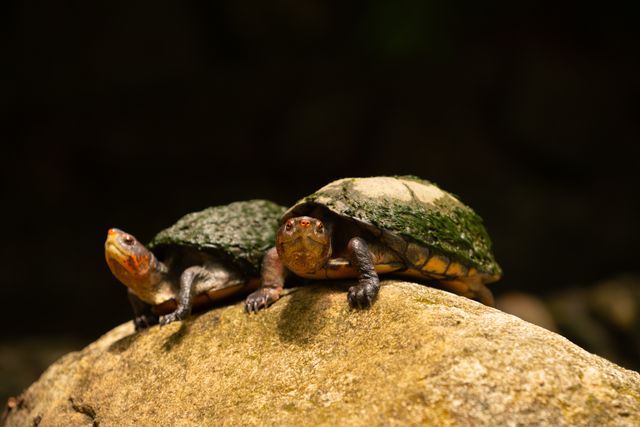
A basking light is an important part of keeping many pet turtles healthy, but it shouldn’t stay on around the clock.
For most pet turtles, the basking light should be on for about 10 to 12 hours each day and turned off at night. This schedule creates a regular day-and-night cycle similar to what turtles experience outdoors.
Your turtle’s exact lighting needs can vary depending on its species, enclosure, room temperature, season, and other factors. The goal is to provide enough daytime heat and light for normal basking behavior without eliminating the darkness turtles need at night.
How Many Hours a Day Does a Turtle Need a Basking Light?
A good starting point for many commonly kept turtles is 10 to 12 hours of basking light per day.
For example, you might turn the basking light on at 8 a.m. and turn it off at 8 p.m. A timer makes it easy to maintain the same schedule every day without manually switching the light on and off.
The schedule doesn’t need to match these exact hours. What matters is establishing a predictable daytime and nighttime routine.
A turtle’s basking area provides warmth that allows the animal to raise its body temperature. Because turtles are ectothermic, their body temperature is heavily influenced by their environment.
Your turtle should be able to move freely between its warmer basking area and cooler areas of the enclosure. This allows it to regulate its temperature by changing locations rather than being exposed to constant heat.
Should a Turtle Basking Light Stay On All Day?
The basking light can remain on throughout your turtle’s daytime period, which will usually be around 10 to 12 hours.
You don’t need to turn the light on only when you see your turtle basking.
Your turtle should be able to decide when it wants to climb onto the basking platform, warm itself, and return to the water or another part of its habitat.
Constantly switching the lamp on and off can make the environment less predictable. A timer provides a much more consistent schedule.
Should You Leave a Turtle Basking Light On at Night?
No. A turtle’s basking light generally should be turned off at night.
Turtles need periods of darkness as part of a normal day-and-night cycle. Leaving bright basking lights on 24 hours a day can interfere with that cycle.
If you normally go to bed at 11 p.m., however, that doesn’t mean your turtle’s light has to stay on until then. Its schedule can be independent of yours.
For example, a timer could automatically turn the lights on at 7 a.m. and off at 7 p.m.
The important part is consistency.
Do Turtles Need Heat at Night?
Turning off the basking lamp doesn’t necessarily mean every turtle enclosure should become cold at night.
Whether additional nighttime heat is necessary depends on the turtle species and the temperatures in the enclosure.
For aquatic turtles, a properly sized aquarium heater may be used to maintain an appropriate water temperature even when the basking lamp is off.
If nighttime temperatures remain safely within the appropriate range for your particular turtle species, additional nighttime heating may not be necessary.
If supplemental nighttime heat is required, avoid using a bright basking bulb to provide it. Your turtle should still experience darkness.
Because temperature requirements vary considerably among species and life stages, check the husbandry recommendations for the particular turtle you keep rather than relying on a single temperature recommendation for every turtle.
Why Turtles Need a Day-and-Night Cycle
A consistent lighting schedule does more than tell your turtle when its basking spot is available.
Light and darkness provide environmental cues that help establish normal daily activity patterns.
In nature, turtles don’t experience continuous daylight. Sunrise and sunset create predictable periods of light and darkness. An indoor enclosure should provide a similar distinction.
Keeping enclosure lights on 24 hours a day removes that natural cycle.
A timer is one of the easiest ways to prevent this problem. Once programmed, it can turn the enclosure lights on and off at the same times every day.
What Does a Turtle Basking Light Do?
A basking lamp creates a warm area where a turtle can leave the water or move away from cooler parts of its enclosure and increase its body temperature.
For aquatic turtles, the basking platform should allow the turtle to climb completely out of the water and dry off.
The basking lamp should heat this specific area rather than the entire enclosure to the same temperature. Your turtle needs access to different temperatures so it can move between warmer and cooler areas.
The proper basking temperature depends on the species. Juveniles, adults, and turtles with particular health needs may also require somewhat different conditions.
Rather than assuming that the presence of a lamp means the temperature is correct, measure the basking area with an appropriate thermometer.
Is a Basking Light the Same as a UVB Light?
No. Heat and UVB serve different purposes, even though some reptile lighting products can provide both.
Basking lights
A basking lamp primarily provides heat. It creates a warm spot where your turtle can raise its body temperature.
UVB lights
UVB lighting provides ultraviolet B radiation. UVB exposure helps reptiles synthesize vitamin D3, which plays an important role in calcium metabolism and bone and shell health.
Many indoor turtle setups therefore require both an appropriate heat source and UVB exposure.
Some bulbs are designed to produce both heat and UVB, while other enclosures use separate bulbs. Always check exactly what a particular bulb produces rather than assuming any lamp marketed for reptiles provides both.
How Long Should a Turtle UVB Light Stay On?
For many pet turtles, the UVB light can follow the same 10-to-12-hour daytime schedule as the basking light.
Both can be connected to timers so they turn on in the morning and off at night.
Keep in mind that a UVB bulb can continue producing visible light even after its UVB output has declined. That means a bulb isn’t necessarily providing adequate UVB just because it still lights up.
Follow the manufacturer’s replacement recommendations for the specific UVB bulb you use.
Placement also matters. The distance between the UVB source and basking area, the type of bulb, and anything positioned between the bulb and turtle can affect UVB exposure.
Can You Use a Regular Light Bulb for a Turtle?
A regular household bulb shouldn’t automatically be considered an adequate replacement for proper reptile lighting.
A heat-producing bulb may create warmth, but that doesn’t mean it provides UVB.
Your turtle’s enclosure should be designed around its specific requirements for heat, UVB exposure, visible light, water temperature, and basking temperature.
Check the specifications of any bulb you plan to use so you know exactly what it provides.
How Hot Should a Turtle Basking Area Be?
There isn’t one ideal basking temperature for every turtle.
Species commonly kept as pets can have different temperature requirements, and factors such as age and health can also affect husbandry recommendations.
Red-eared sliders, painted turtles, box turtles, and other popular species shouldn’t automatically be treated as though their environmental requirements are identical.
Find temperature recommendations specifically for your turtle species and use a thermometer to verify the actual temperature of the basking area.
Don’t estimate the temperature by placing your hand underneath the lamp. What feels warm to you doesn’t tell you whether the basking surface is at an appropriate temperature for your turtle.
How Far Should a Basking Light Be From a Turtle?
The correct distance depends on the bulb, wattage, fixture, enclosure, and temperature you’re trying to achieve.
That makes a universal recommendation such as “place the bulb six inches away” potentially misleading.
Start with the lamp manufacturer’s placement instructions and measure the actual temperature at the turtle’s basking surface.
If the basking area is too cool, your turtle may not receive enough warmth. If it’s too hot, the turtle could avoid the area or potentially be injured.
The lamp should also be positioned securely so your turtle cannot touch the hot bulb or fixture.
How to Tell if Your Turtle’s Basking Area Is Too Hot
Don’t rely solely on your turtle’s behavior to determine whether the temperature is appropriate. Measure it.
However, behavior can provide additional clues that something in the habitat deserves attention.
A turtle that consistently avoids its basking platform may be responding to excessive heat, an inaccessible platform, poor placement, stress, or another environmental issue.
Likewise, a turtle that spends unusually long periods basking may be responding to conditions elsewhere in the enclosure.
Changes in basking behavior can have multiple explanations, including health problems. Persistent or significant changes should be discussed with a veterinarian experienced with reptiles.
What if Your Turtle Isn’t Basking?
Not seeing your turtle bask doesn’t necessarily mean it never does. Some turtles climb onto their basking platforms when the room is quiet and quickly return to the water when people approach.
If your turtle truly isn’t basking, check the enclosure.
Make sure the platform is easy to access, completely supports the turtle, and allows an aquatic turtle to get out of the water. Verify the basking temperature and make sure the lighting is positioned correctly.
Also consider whether the turtle has enough privacy to feel comfortable leaving the water.
If a turtle that normally basks suddenly stops, particularly if you notice other changes in appetite, swimming, activity, eyes, breathing, skin, or shell condition, contact a reptile veterinarian.
Should Turtle Lighting Change With the Seasons?
Some turtle keepers adjust lighting schedules slightly throughout the year to mimic seasonal changes in daylight.
Whether this is appropriate depends on the species and how closely you’re attempting to replicate its natural environment.
For a typical indoor pet setup, maintaining a consistent 10-to-12-hour schedule is often easier than making frequent adjustments.
More significant seasonal changes shouldn’t be made without understanding the natural history and husbandry requirements of the species.
This is particularly important if you’re considering brumation. Brumation involves much more than simply reducing the number of hours a basking lamp stays on and shouldn’t be attempted casually.
Can You Leave a Turtle Alone With the Basking Light On?
A properly installed reptile lighting setup is designed to operate for hours at a time, but heat lamps need to be treated carefully.
Use fixtures rated for the type and wattage of bulb installed. Keep lamps securely positioned and away from flammable materials. Cords should also be protected from water and positioned so your turtle cannot reach them.
Avoid improvising with fixtures that aren’t designed to handle the heat produced by the bulb.
A timer can control the lighting schedule when you’re away from home, but it doesn’t replace proper installation and regular equipment checks.
How to Set Up a Turtle Lighting Schedule
You don’t need to manually manage your turtle’s lights every morning and evening.
An inexpensive outlet timer can handle the schedule for you.
A basic routine might look like this:
7 a.m. – Basking and UVB lights turn on
7 p.m. – Basking and UVB lights turn off
That provides 12 hours of light followed by 12 hours of darkness.
An 8 a.m. to 6 p.m. schedule would provide 10 hours of daytime lighting. Either can fall within the typical range for many pet turtles.
Choose a schedule appropriate for your turtle species and maintain it consistently.
While you’re setting up a routine, don’t forget that lighting is only one part of turtle care. Water quality, diet, temperature, enclosure size, UVB exposure, and access to an appropriate basking area all work together to create a suitable habitat.
Common Turtle Lighting Mistakes
A few lighting mistakes can create problems even when the enclosure appears properly equipped.
Leaving the lights on 24 hours a day
More light isn’t necessarily better. Turtles need a regular period of darkness.
Using heat without UVB
A basking bulb that produces heat isn’t automatically providing UVB. Check the bulb specifications.
Assuming a glowing UVB bulb still works properly
Visible light doesn’t tell you how much UVB a bulb is producing. Replace UVB bulbs according to the manufacturer’s recommendations.
Guessing the basking temperature
Use a thermometer rather than judging temperature by touch.
Putting the lamp too close
An improperly positioned heat lamp can create excessively high surface temperatures and potentially cause burns.
Ignoring the turtle species
Not every turtle requires exactly the same temperature, lighting intensity, or enclosure conditions. Husbandry should be based on the species you’re keeping.
Frequently Asked Questions
How long should I leave my turtle’s basking light on?
For many pet turtles, 10 to 12 hours per day is a practical starting point. Turn the basking light off at night to provide a normal period of darkness.
Can I leave my turtle’s basking light on overnight?
Generally, no. Bright basking lights should be turned off at night so your turtle has a regular day-and-night cycle. If your turtle requires additional nighttime heat, use an appropriate heating method that doesn’t produce bright light.
Do turtles need UVB light at night?
No. UVB lighting can generally be turned off along with the other daytime enclosure lights at night.
Can turtles go one night without a heat lamp?
Whether a turtle needs supplemental heat overnight depends on its species and the temperatures in its enclosure. Many setups don’t require a bright heat lamp overnight, but temperatures should remain within the appropriate range for the species.
Should the basking light and UVB light be on at the same time?
They commonly are. Many keepers put both lights on the same timer so the turtle receives heat, visible light, and UVB exposure during its daytime period followed by darkness at night.
What time should I turn my turtle’s basking light off?
There isn’t one required clock time. Choose a schedule that provides approximately 10 to 12 hours of daytime lighting and a consistent period of darkness. For example, the light could run from 7 a.m. to 7 p.m.
Does a turtle need a basking light every day?
For turtle species that require a heated basking area, the basking light should normally be available every day as part of the animal’s regular husbandry routine.
Keep Your Turtle’s Lighting Schedule Consistent
For most pet turtles, a basking light should be left on for about 10 to 12 hours per day and turned off at night.
Using a timer makes that schedule easy to maintain and gives your turtle predictable periods of daylight and darkness.
Just remember that the number of hours the lamp stays on is only part of the equation. Proper basking temperature, UVB exposure, water temperature, lamp placement, and species-specific requirements are equally important.
A consistent lighting schedule combined with a properly designed habitat gives your turtle the opportunity to bask when it needs to and retreat to cooler areas when it doesn’t.
